The One-Slide Rule: Why Your Deck Is Working Against You
Most slide decks fail because they overload working memory. Here’s a simple rule that fixes a surprising amount: one slide = one job—and a quick test to keep your deck clear and persuasive.
PRESENTATIONS & PERSUASION
Adam Bair
1/19/20261 min read
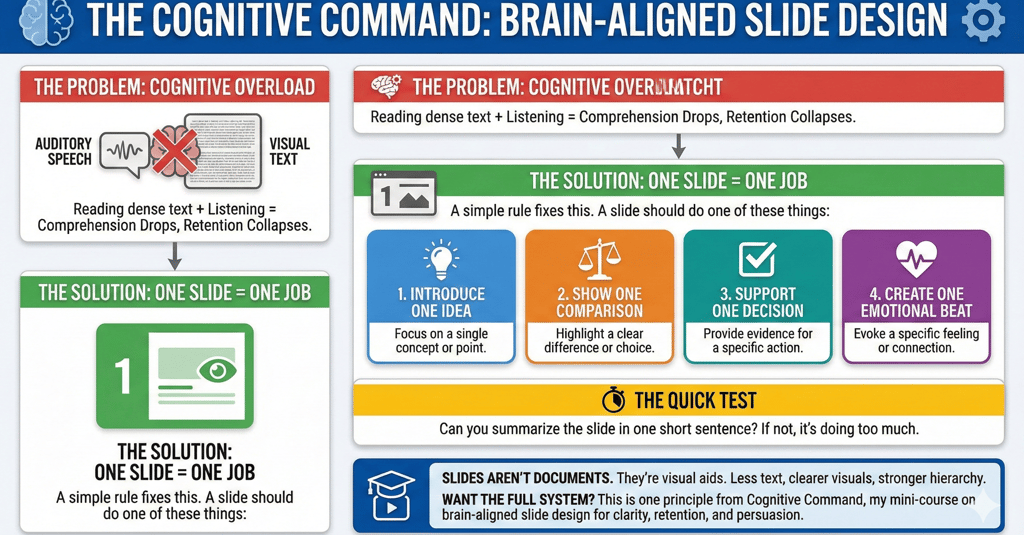
Most slide decks fail because they overload working memory. When your audience is reading dense text while listening to you speak, comprehension drops and retention collapses.
A simple rule fixes a surprising amount of this:
One slide = one job.
A slide should do one of these things:
introduce one idea
show one comparison
support one decision
create one emotional beat
If a slide tries to do three jobs, the audience does none of them well.
A quick test: if you can’t summarize the slide in one short sentence, it’s doing too much.
Slides aren’t documents. They’re visual aids that support a spoken message. Less text, clearer visuals, stronger hierarchy—and your audience will actually follow you.
Want the full system? This is one principle from Cognitive Command, my mini-course on brain-aligned slide design for clarity, retention, and persuasion.
Connect
Reach out for insights or collaboration.
Call
1-888-998-3317
© 2026. All rights reserved.